Immediate Response
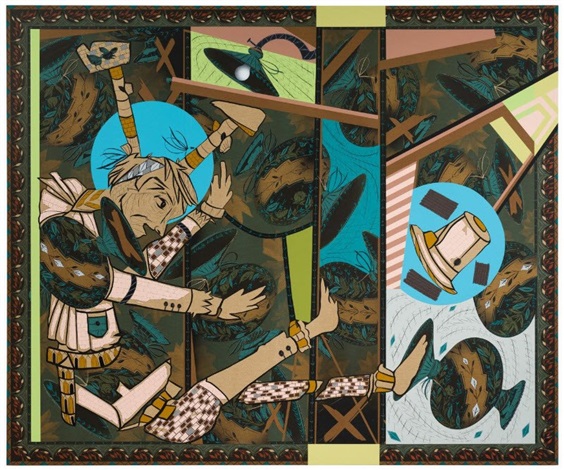
The first idea that comes to mind for a number of Pittman’s drawings, especially the one above, is “Ancient Egypt.” A combination of irregular body positioning, foreign or alien looking objects, and the coloring is what pushes this initial thought into my mind. As I search deeper into the paintings contents, objects like the lamp in the top middle deter me from the thought, but nonetheless, it persists as I continue looking. The title of the painting, “found buried #4,” is a reassuring component as well for obvious reasons. Regardless, the piece makes me feel uneasy as I am not completely aware of the artist’s intentions.
Objective Description
Imagine a strange looking human falling through an abyss–arms and legs flailing. The abyss is broken into four parts, all of which are more or less identical with brown and a dark forest green background. Scattered across the abyss are vases with a very similar color scheme. The man is dressed in a beige garment with gold cuffs around his ankles and two axe looking objects stemming from his head. If you are confused, welcome to the club. The piece in fringed by brown and black half circles.
Technical Decisions
This is a very dynamic composition with many components at hand. One viewing the piece is unable to stand back and view it like a landscape, instead needing to move around and focus on the different aspects. Pittman achieves this dynamic nature using repetition–with the same object scattered across many times. Pittman’s intricately constructed paintings transform pattern and signage into opulent sceneries full of complexity, contrast, and yearning. Pittman conveys themes of romantic love, violence, and mortality through anthropomorphic depictions of furniture, weaponry, and animals that are rich in symbolism.
The Work in the World
There are two objects in the piece that draw particular attention–an axe and a number of vases. While the vases appear to be intact and unbroken, one can feel a sense of unease knowing the problems that might arise when one comes into contact with the other. Exquisite decor and weapons of destruction; a bull in a china shop. Pittman’s work often connects to his Colombian roots. It is possible this piece connects to a similar theme, how culture has historically been corrupted at the hands of others. With so many elements, it is very difficult to pinpoint the pieces intention, but nonetheless remarkable the thoughts that stem from its viewing.
The Story it Tells
Pittman’s works shows how beauty and sorrow, pain and pleasure, are complementary, and they draw the viewer’s attention to bittersweet experiences and the value of emotion in art. In the painting presented, we see the contradicting points of viewership, pretty and warm colors juxtaposed by falling and confused man. Pittman’s use of concurrently happening tales and lavish imagery represents the rich multiplicity of American society, the artist’s Colombian origin, and the distorting effects of hyper-capitalism on everyday life, despite subject matter that varies from series to series.